For anyone missing most or all of their teeth in an arch, the real decision usually comes down to two options: traditional removable dentures, or a fixed full arch implant solution (often called All-on-4 or All-on-6, depending on how many implants are used). Both restore a full smile, but they work very differently day to day. Here’s an honest look at how they compare.
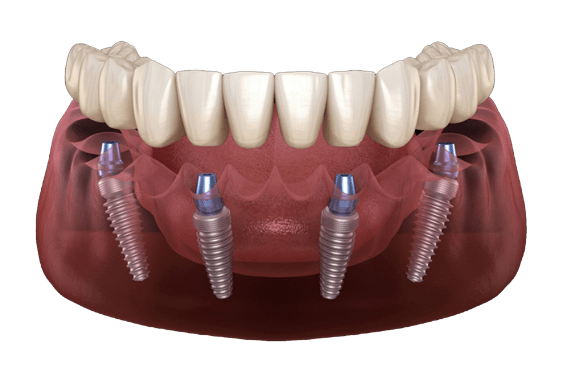
This is the fundamental difference between the two options. Dentures rest on the gums and are held in place by suction, adhesive, or a combination of both, but they aren’t permanently fixed to anything. Full arch implants are anchored directly into the jawbone using a small number of strategically placed implants (commonly four, five, or six), which then support a fixed prosthesis that doesn’t come out.
This distinction shapes almost every other difference between the two options.
Because dentures sit on the gums rather than being anchored to bone, they typically restore a fraction of natural biting force, often estimated at around 20 to 30 percent of a natural bite. This is part of why denture wearers often need to avoid harder or chewier foods.
Full arch implants, being anchored directly into bone, restore significantly more of a natural bite, often approaching the strength of natural teeth. Most patients with full arch implants can eat a much broader range of foods without the same restrictions.
Dentures need to be removed for cleaning and typically soaked overnight, along with regular checks for fit as the gum and bone shape naturally change over time. They also usually need adjustment or replacement every 5 to 7 years as the mouth’s shape shifts.
Full arch implants are cared for much like natural teeth, brushing and specialised flossing tools designed for the fixed prosthesis, along with regular professional check-ups. There’s no removing them for cleaning, and no daily soaking routine.
Removable dentures can occasionally shift during speaking or eating, particularly lower dentures, which have less natural suction than upper ones. Some denture wearers adapt fully, but a portion continue to notice occasional slipping, especially over time as the fit changes.
Because full arch implants are fixed in place, this kind of movement isn’t a factor. Most patients report their speech feels close to how it did with natural teeth, without the adjustment period some denture wearers experience.
This is one of the more clinically significant differences. Natural tooth roots provide ongoing stimulation to the jawbone, which is part of what keeps it from gradually resorbing (shrinking) over time. Dentures rest on top of the gum and don’t replicate this stimulation, which is why long-term denture wearers often experience gradual bone loss, sometimes leading to looser-fitting dentures over the years and changes in facial shape.
Implants, because they’re anchored directly into the bone, provide similar stimulation to natural tooth roots and help preserve bone volume over time. This is often cited as one of the more significant long-term advantages of implants over dentures, beyond day-to-day comfort.
The implant posts themselves, once successfully integrated, can last decades, in many cases 20 years or more. The prosthetic bridge attached to them typically has a shorter lifespan, often 10 to 15 years, depending on wear, bite forces, and maintenance, though this still generally outlasts a typical denture’s five to seven year replacement cycle.
Dentures involve a lower upfront cost but tend to need more frequent adjustment, relining, or full replacement over the years as the jaw’s shape changes. Implants involve a higher upfront investment but tend to require less ongoing replacement over the long term.
Patients who prioritise the lowest upfront cost, or who aren’t suitable candidates for implant surgery due to insufficient bone density or certain health conditions, often find dentures the more practical option, sometimes combined with bone grafting or denture stabilising implants as a middle-ground solution.
Patients who prioritise chewing function, long-term bone preservation, and not having to remove their teeth daily tend to prefer full arch implants, provided they’re suitable candidates for the required surgery and healing process.
Neither option is universally right, it depends on individual health, budget, and lifestyle priorities. A proper assessment, including bone density evaluation, is the only reliable way to know which suits your specific situation.
Often yes, though it depends on individual bone health at the time. Some patients start with dentures and transition to implants later, while others move in the opposite direction if implant treatment isn’t suitable for them.
Most patients report a close adjustment period, generally shorter than adapting to dentures, since the fixed nature of implants closely mimics how natural teeth feel and function.
Not always. It depends on how much bone density remains in the jaw, which is assessed during the initial consultation through imaging.
Not in the way dentures are removable day to day, but the prosthesis itself can be removed and replaced by a dentist if needed for maintenance or repair. The implants themselves are intended as a long-term, fixed solution.
This depends on your bone density, general health, budget, and personal priorities around function versus cost. A consultation with imaging is the most reliable way to get a clear recommendation for your specific case.
Related reading: Dental Implants | Cosmetic Dentistry | Invisalign
If you’re weighing up full arch implants against dentures for your own situation, book a consultation to have your bone density and suitability properly assessed.
Whether you are considering teeth whitening, alignment options, or restorative treatments, our team at Dental Galleria provides professional dental care tailored to your needs. We focus on supporting your oral health and helping you maintain a functional and comfortable smile.
Book your appointment today to discuss the treatment options suitable for you.
We are located at, 4/90
Charles St, Putney NSW 2112
© 2025 Dental Galleria. All rights reserved.
Website By 360 Dental marketing


