“Composite veneers” and “composite bonding” get used almost interchangeably in casual conversation, but they’re not quite the same treatment, and mixing them up can lead to a mismatch between what a patient expects and what’s actually recommended. This guide clears up the distinction and helps you understand which one might suit a particular concern.
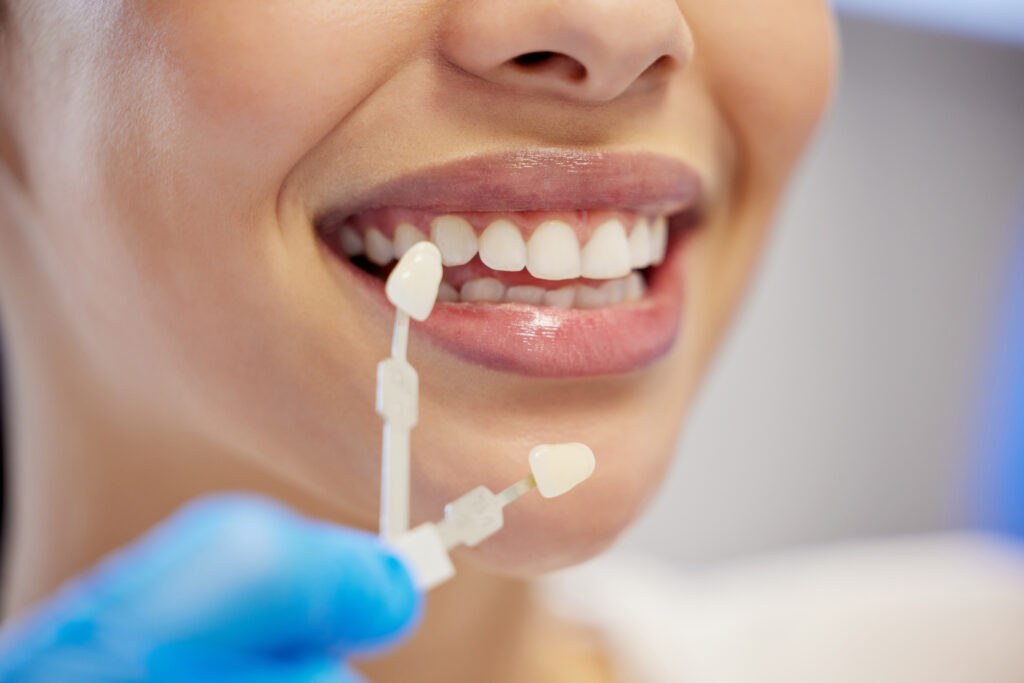
Composite bonding is a targeted, tooth-by-tooth treatment. A tooth-coloured resin is applied directly to a specific area of a tooth, usually to fix a small chip, close a minor gap, or reshape a slightly irregular edge. It’s typically used on one or two teeth at a time as a spot fix, rather than as a broader smile treatment.
Bonding is usually the more conservative and lower-cost option of the two, and it can often be completed in well under an hour per tooth, sometimes without any anaesthetic needed at all, since it doesn’t usually require touching the surface of the whole tooth the way a veneer does.
Composite veneers use the same resin material as bonding, but they’re applied as a fuller layer covering the entire visible front surface of a tooth, not just a small chipped area. They’re generally used across several front teeth at once to create a more cohesive, uniform look, addressing shape, size, colour, and alignment together rather than fixing one small imperfection.
Because they cover the whole visible surface, composite veneers usually take longer to place than a single bonding treatment and involve more careful shade matching and sculpting to look natural across multiple teeth.
| Composite Bonding | Composite Veneers | |
|---|---|---|
| Coverage | Small, targeted area of one tooth | Full front surface, usually several teeth |
| Typical use | Fixing a chip, gap, or minor irregularity | Broader cosmetic enhancement across a smile |
| Time per tooth | Often under an hour | Longer, due to shaping and shade matching |
| Cost | Generally the more affordable option | Higher, due to more material and chair time |
| Best for | One-off, localised concerns | Multiple teeth needing a unified look |
Both use the same underlying resin material, which is why they share similar durability characteristics, typically 5 to 7 years before needing attention, and both can usually be repaired directly if chipped, rather than needing full replacement the way porcelain often does. Whichever you choose, our veneers aftercare guide covers the daily habits that help either option last as long as possible.
A single chipped front tooth, a small gap between two teeth, or a slightly uneven edge is often better suited to bonding, since it directly targets the specific issue without the cost or time of treating teeth that don’t need it.
Multiple teeth with a combination of concerns, mild discolouration, uneven sizing, small gaps across the smile, tends to suit composite veneers better, since treating several teeth together as a set achieves a more consistent, balanced result than bonding each one individually.
Neither is automatically the “better” treatment, the right choice depends entirely on what’s actually being addressed. A dentist assessing your specific smile is really the only reliable way to know which approach fits your situation, since photos and generic advice can’t account for your individual tooth shape, bite, and alignment.
Yes, this is one of the more flexible aspects of working with composite material. If a small bonding repair no longer looks quite right alongside the rest of your smile, it’s often possible to build on it or transition toward fuller composite veneers later, since the material bonds well to itself. This flexibility is part of why composite is often recommended as a starting point for patients who aren’t sure yet how extensive a cosmetic change they want.
No, bonding is considered a semi-permanent treatment, generally lasting several years before it may need touching up or replacing, depending on wear and care.
Usually very little to none, which is part of why it’s considered a conservative, reversible option compared to more invasive treatments.
It can help mask mild to moderate discolouration, but significant or deep discolouration is often better addressed with a composite or porcelain veneer, which provides fuller coverage.
As a general guide, if you’re only concerned about one small, specific imperfection, bonding is often sufficient. If you’re looking to change the overall look of several teeth together, veneers are usually the more suitable option, whether composite or porcelain. If durability and long-term stain resistance matter most to you, it’s worth reading about how long porcelain veneers really last as a point of comparison. A consultation will confirm which applies to your case.
Most bonding treatments require little to no anaesthetic and are generally described as comfortable, since minimal to no tooth preparation is involved.
Related reading: Veneers Aftercare Guide | Porcelain Veneer Longevity | Veneers | Cosmetic Dentistry
If you’re weighing up bonding versus veneers for your own smile, book a consultation so your dentist can recommend the right approach for you specifically.
Whether you are considering teeth whitening, alignment options, or restorative treatments, our team at Dental Galleria provides professional dental care tailored to your needs. We focus on supporting your oral health and helping you maintain a functional and comfortable smile.
Book your appointment today to discuss the treatment options suitable for you.
We are located at, 4/90
Charles St, Putney NSW 2112
© 2025 Dental Galleria. All rights reserved.
Website By 360 Dental marketing


